
Finding My Superpowers
A superpower is something you are both good at and something you love to do. Finding, developing, and using these takes you to the next level. When you use your superpower it gives you energy. Folks can see your passion and your work speaks for itself.
I found one of my superpowers while taking Improv classes to get more comfortable on stage. I helped make the team shirts. I wasn’t an artist. But I recognized an artist in the class, organized a sign-up form, and found a company that could print the shirts for us. I’m good at making things happen and love unique one-of-a-kind memories from these classes. I liked it so much I’m getting known for organizing small batch artist products and it’s something I love to do.
“In a world that is too busy to really care about you and your strengths, the responsibility falls to you to apply your strengths consciously every day.”
— Marcus Buckingham, StandOut 2.0
This has led me down a path where I’m intentionally thinking about my strengths, values, and where I can make the most impact.
Identifying “unconscious competence”
In a world with billions of people, it’s not uncommon to feel imposter syndrome. For any given task it always seems there is someone better. But I want to turn that on its head. For the many things unique about me, there aren’t that many folks that have that combination of skills. This isn’t about being a generalist but about how you put together your unique skills to make something bigger than the individual tasks.
A few things I never even identified as skills until they were pointed out to me. One, being an engaging speaker and storyteller, as I learned at Toastmasters. Another, using interesting and engaging analogies to make complex topics easier to understand, learned from my coworkers’ feedback.
A highlight that really stuck with me from Melody Wilding was to not discount my strengths because they came easily.
“The things that come easily to you are your strengths, so don’t discount them because they feel innate. This is called unconscious competence, or when you can perform a skill to such a high degree of mastery that it feels second nature.”
— Melody Wilding, Managing Up
Strategy of elimination
Being truthful about what you really don’t like even if you are good at it is hard, but is one of the most valuable ways to focus your energy.
“Some of us want to do a million different things, and some of us have no idea what we want to do, but most of us know what we don’t want to do. Which is why I always encourage people to start with acknowledging what they don’t want to do.”
— Cynthia Johnson, Platform
A mentor recommended to me to keep a grid with labels “Know I like, Think I like, Know I hate, Think I hate”. If you write as you are doing your daily tasks, it starts to become clear pretty quickly. As I did tasks I asked myself, does this give me energy or take energy away? Things that gave me energy went on the top.
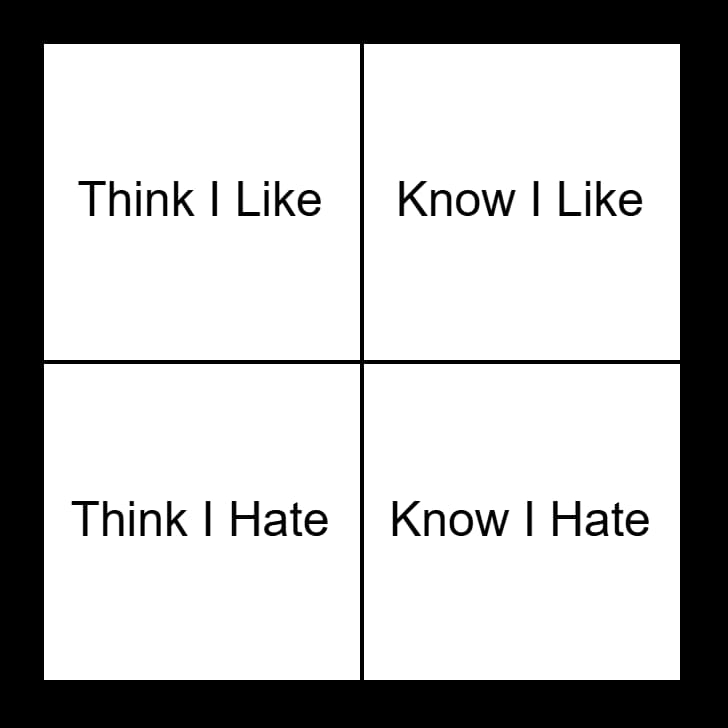
Items in the top and especially the top right are what you should do more of to get more energy and be more authentic. Figuring out how to stop the items on the bottom takes some strategy and intentional planning.
I would look for where you can have an AI do the things you hate, especially if they are boilerplate admin routines.
Three questions to reflect on
I like the John Blattner questions that Gail Golden highlights in her book.
“Dr. John Blattner taught me three questions to ask myself about my work:
- Am I doing good work?
- Am I having fun?
- Am I making money?”
— Gail Golden, Curating Your Life
I use them when reflecting weekly and when a project ends. The questions above from Gail Golden are something I reflect on a lot. Technically, question 3 about money is optional. If you are working on a passion project you might want to consider recognition or satisfaction instead of monetary gain.
Constantly reviewing these also helps to know when you or the world might be changing as you develop new skills and competencies. The answers to these questions and how they change over time are always insightful for me. I keep them in a notebook.
Social indicators
But you can only do self-review to a point. It’s important to look for other indicators to validate where you might be too tough or nice on yourself.
If you are fortunate to have a mentor, ask them what unique traits they see in you. If you don’t have a mentor, you can try various assessments. Toastmasters provides assessments through their pathways program about your leadership and communication styles. The book StandOut 2.0 also has a free assessment on the ADP website, StandOut Assessment Powered by ADP. You can later pay for personal coaching by the hour.
While I appreciated the StandOut assessment, I didn’t use their coaching. I wanted something more hands-on and community based to work with my strengths.
Instead I used Toastmasters and the mentoring from my local club to fine-tune my skills. This was a safe space with like-minded learners. Then I looked for clues at what my superpowers were, including where they could be put to good use. For example, being asked to do Lunch and Learns, creating presentations and demo stories, building business case stories.
Play to your authentic strengths
This is really key. You are most natural when you can be your authentic self. This takes some practice as we often act a little differently in public. However, accepting our strengths and offering those to others has a great impact. Not just in work but in your private life as well.
Find that thing that sets you apart, like my organizing the artist shirts for my improv teams. Dig into it in a structured way and then make a difference.
Further reading
-
Marcus Buckingham, StandOut 2.0
My takeaway from this book was to embrace what made you unique and gives you energy. Don’t try to be something you aren’t.
View on Goodreads -
Gail Golden, Curating Your Life
My takeaway from this book was being intentional. You only have so much energy and can’t do it all. While most of us focus on additive solutions sometimes it’s best to simplify and remove to focus on what you care deeply about.
View on Goodreads -
Melody Wilding, Managing Up
Key point I learned from this is to take your superpowers and advertise them so you get the opportunity to use them. This is a win-win for both you and your company when you do your best work. But they need to know what you are good at!
View on Goodreads